The Hardest Sales I Ever Made Had No Product: What Nonprofit & B2B Marketing Have in Common
A donor once asked our team what their $20,000 would buy. Not rhetorically. They wanted the numbers: cost per outcome, how we calculated it, assurance it would go to a specific program, and how we would report out on the gift's impact.
They wanted to know which specific costs their money would cover and which it wouldn't. They wanted reporting: what changed, for how many people, measured how, delivered on a schedule rather than whenever the annual report came out.
That is a scoped contract with success criteria and a reporting cadence. They called it a gift.
And that meeting was not the beginning of the relationship. It was the progress of one that had been running for YEARS. It took one dedicated teammate and the whole team jumping in at different points to get it done.
It's worth saying why they asked all of it. They weren't being difficult, and they weren't running a test to see how we'd handle pressure. They had given before, somewhere else, and it had gone badly: money that disappeared into a general fund, no reporting, and results that didn't match what had been promised. It was fair that they asked us to prove our impact and keep our promises.
So the spreadsheet wasn't skepticism about our mission. It was risk management. Every question they asked was really the same question: what happens if I trust you and I'm wrong again
That question has a direct commercial equivalent, and anyone who has sold into an account after a failed implementation knows exactly what it sounds like.
I've worked across nonprofit, e-commerce, and B2B marketing. I've marketed causes, physical products, and technology. And the hardest sale I ever made was one where the buyer walked away holding nothing but a promise and hope.
Selling a $1,500 coffee grinder was easier.
I bring this up because nonprofit marketing experience is often treated as a different discipline from tech or B2B marketing. Mission-driven? Yes. Scrappy? Always. But somehow that turns into: That's great, but B2B is different.
Of course it's different. But the fundamentals of good marketing aren't nearly as different as people think.
Donor Cultivation Is a Years-Long Sales Cycle, and Never One Person's Work
The thing that gets lost when a gift is described as a gift is how long it took and how many people it took.
That $20,000 started as a small first donation from someone who found us through a campaign they probably don't remember. What followed was years of deliberate, coordinated work. Email programs that kept them engaged between asks. Event invitations, and tracking who actually showed up. Program updates written for someone who wanted evidence, not sentiment. A site visit. A team member who knew them personally and made the introduction. Meetings with program staff who could answer questions. Development pulling numbers and leadership showing up when the relationship called for it.
And long stretches where the correct move was to ask for nothing at all, because asking too early would have cost more than waiting. With a donor who has been burned before, that restraint isn't patience for its own sake. An early ask confirms the thing they are afraid of: that they are just a checkbook.
Marketing didn't close that gift. Marketing built the conditions that made closing possible, and then a team executed across years of touchpoints, most of which produced no revenue on the day they happened.
If that sounds familiar, it should. That is a complex enterprise sale: a long cycle, multiple stakeholders, an internal champion, a committee that has to agree, a buyer who does independent research, and a close that arrives long after the work that earned it. Nobody looks at an eighteen-month enterprise deal and calls it easy. Nonprofit cultivation cycles routinely run longer than that
The vocabulary is softer. The work isn't.
In Nonprofit Marketing, the Product Is Impact
People assume nonprofits have no product. That's not quite right. The product is the mission and the impact it produces. It's just that the buyer isn't the one who receives it.
That single difference changes everything downstream.
A B2B customer gets something for their money: software, a service, a new capability, a solution to a problem. There's usually a budget for it and a business case someone can take to their boss. An e-commerce customer has an even clearer exchange. Give me money and I give you the thing
A donor gets a receipt.
There's no budget category. The money comes out of the same pool as the vacation, the kitchen remodel, the college fund. There's usually no natural deadline except the one you create through a campaign, matching gift, event, or year-end appeal.
What you're selling is the belief that your organization can turn someone's money into meaningful change, and that they should choose you over thousands of other organizations asking for that same money.
Then you have to convince them to do it again.
That's demand generation. That's acquisition, conversion, lifecycle marketing, retention, and brand trust. We just use different words for some of it.
Proving Impact Before It Exists Is the Nonprofit Business Case
This is the part I'd argue is genuinely harder than selling a product, and it's where most of the actual work goes.
If you sell software, you can demo it. The buyer sees the thing working, in the room, before any money moves. If you sell a coffee grinder, they can enjoy coffee from it. Whatever doubts remain are about fit and price, not about whether the object exists.
A donor is being asked to fund something that hasn't happened yet, that they will never personally observe, and that will occur somewhere else for someone they'll never meet. There is no demo. There is no trial. The product doesn't exist at the moment of purchase. Their money is what brings it into existence, and they have to believe that before they'll release it.
So you build the proof from evidence rather than demonstration. Program data showing the intervention works. A cost-per-outcome model you can defend line by line, including the assumptions inside it. Independent evaluation from someone with no stake in the answer. A track record of prior commitments met. Financials that hold up when a donor with a spreadsheet goes looking for the gap between what you spend on programs and what you spend on everything else.
And you have to be honest about attribution, because sophisticated donors will find the seam if you aren't. Outcomes have many causes. Claiming a result was entirely yours is the fastest way to lose someone who's read the literature, and the ones asking the hardest questions have usually read the literature.
The commercial version of this is the business case. Projected ROI, payback period, benchmarks from comparable customers, analyst validation, reference calls, and a pilot if the buyer wants proof before the full commitment. Both are arguments about a future that hasn't happened, built from evidence about futures that already did.
The difference is that a B2B buyer eventually gets to check. They deploy the thing and find out whether the business case was real. A donor mostly has to take the reporting's word for it, which is exactly why the reporting has to be good, and exactly why a donor who's been let down once demands so much more of it.
What Nonprofit and B2B Marketing Have in Common
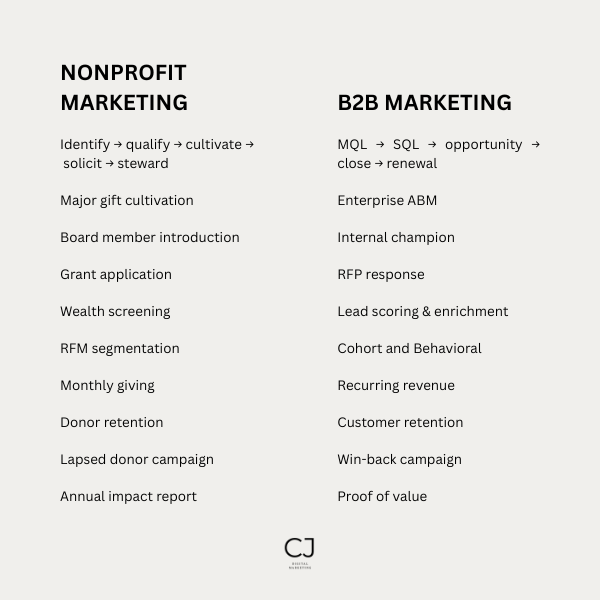
The terminology changes. The underlying strategy doesn't change that much.
You need to find the right audience, understand what motivates them, earn their attention, build trust, convert them, retain them, and demonstrate enough value that they choose you again.
Donor Journeys and Customer Journeys Follow the Same Lifecycle
A donor welcome series triggered after a first gift is onboarding. Moving a first-time donor toward a second gift is activation. A monthly giving upgrade based on giving history is expansion. Stewardship and impact communications support retention. Lapsed-donor campaigns are win-back programs. Peer-to-peer fundraising turns existing supporters into advocates and acquisition channels.
I've built those journeys. The job is the same regardless of what sits at the end of it: understand where someone is in their relationship with your organization and give them the right message at the right time.
One real difference is the data available to make those decisions.
A B2B technology company might have product usage signals: logins, feature adoption, active seats, trial behavior. An e-commerce company has browsing behavior, abandoned carts, and order history.
In nonprofit marketing, intent signals are much softer. Email engagement. Event attendance. Whether someone opened the impact report and how far they scrolled.
You still have to identify intent. You just have less obvious data to work with, which makes the reading harder, not easier.
CRM, Marketing Automation, and Data Don't Care What You're Selling
In many cases it's the same technology.
Salesforce is Salesforce. A messy CRM is a messy CRM. Bad data doesn't become charming because it happened at a nonprofit.
I've run A/B tests on subject lines, asks, offers, and landing pages. I've built automated lifecycle journeys with branching logic. I've cleaned up bad data, rebuilt digital infrastructure, and argued about whether a metric actually meant what we thought it meant.
I've also watched a beautiful campaign get beaten by the boring one, which is a thing that happens in every industry and humbles everyone eventually.
Marketing is marketing.
Donor Retention and Customer Retention Solve the Same Problem
Retention may be where the similarities become most obvious.
With a tangible product, there's a clear feedback loop. The customer paid for something, used it, and can decide whether it delivered enough value to buy again, renew, or expand.
With a donation, the product is real but the buyer never touches it. A donor is trusting an organization to create an outcome that happens somewhere else, for someone else, months or even years later.
That means fundraising can't simply be about the next ask. The reporting is the renewal motion. Every impact update against a restricted gift is a vendor proving it hit the numbers, and donors who set targets remember whether you met them. Get that right and the next conversation starts from trust instead of from zero.
That's retention marketing.
It's also why donor lifecycle programs depend so heavily on segmentation and timing. You don't talk to a first-time $25 donor the way you talk to someone who has given six figures over a decade, just as you wouldn't market to a brand-new prospect the way you communicate with a long-term customer.
Modern Donors Behave a Lot Like B2B Buyers
This is where the comparison gets particularly interesting.
Modern donors increasingly behave like sophisticated buyers. They research organizations before they give. They compare programs. They look at financials. They read third-party evaluations. They want evidence of impact and they want to understand how their money is being used.
They are self-educating, evidence-demanding, and often arrive having already formed an opinion before they ever talk to someone from the organization.
Sound familiar?
B2B buyers are doing the same thing. They research before talking to sales. They compare vendors. They read reviews, ask their peers, and expect useful information long before they're ready to have a sales conversation.
They also carry history. A buyer who sat through a failed rollout, watched a vendor miss every milestone, or had to explain a bad purchase to their boss does not evaluate the next pitch cleanly. They ask for references. They want a pilot before a full commitment. They read the contract for what happens when things go wrong, not for what happens when things go right.
Donors do this too, and it's the part organizations most often misread. A donor asking hard questions is frequently not a hard donor. They are someone who trusted an organization once and got nothing back, and who is now trying to find out whether you are different before risking being wrong twice.
The reassurance they needed wasn't emotional. It was structural: named restrictions, defined metrics, a reporting schedule, third-party verification, and a straight answer about what happens if the program underperforms. Those are the same things a burned enterprise buyer asks for, and for the same reason.
Whether you're asking for a donation or selling technology, earning trust before the conversion is the work. When the buyer has been burned, that work starts from below zero.
Where Nonprofit and B2B Marketing Really Are Different
There are real differences, and pretending otherwise doesn't help anyone.
Pricing and packaging are their own disciplines. Enterprise security review, legal redlines, and multi-year contract structures have no real fundraising equivalent. Sales compensation has its own mechanics. Channel and partner strategies require experience that fundraising simply doesn't provide.
I've worked in B2B, so I've seen the commercial side firsthand, and I'm not going to pretend every discipline maps cleanly across industries. It doesn't.
The part that doesn't hold up is the assumption that building audiences, generating demand, running CRM systems, improving conversion, and retaining donors stops counting as commercial marketing because the conversion was called a gift instead of a sale.
Nonprofit Marketing Isn't Marketing Lite
Convincing someone to fund an outcome that doesn't exist yet, that they may never witness, and that benefits someone they may never meet takes years, a team, and a case built entirely from evidence. Trust gets built across dozens of touchpoints that don't convert on the day they happen. Keeping that person engaged requires lifecycle strategy. Getting them to give again requires proving you did what you said. Finding more people like them requires segmentation, data, and testing.
Those are marketing skills.
The donor ran the process. Shortlist, comparison framework, published financials, third-party verification, scoped spend, defined outcomes, reporting schedule, and a plan for underperformance. Nobody in the room called it that. They were buying reassurance as much as impact, because the last organization they trusted had taught them what it costs to be wrong. I've since sat in enterprise deals that ran on exactly the same logic, with a security questionnaire in place of the 990 and a failed implementation in place of the gift that went nowhere.
The industries change. The buyer changes. The tools evolve. The job is still understanding people well enough to connect them with something worth saying yes to, even when what they walk away holding is only a promise and hope.
And sometimes, selling the $1,500 coffee grinder really is easier. So is the SaaS platform with a free trial and a case study library.